The penal machine

In December 1241 three pirates were captured by the sheriff of Devon and interrogated at Winchester. They were followers of William de Marisco, a notorious pirate based on Lundy island in the Bristol Channel. He also took refuge in Wales: the abbot of Margam in Glamorgan was later accused of sheltering William and his men.
Then, in January 1242, William’s wife was taken prisoner by the men of Bristol. They handed her over to the constable of Gloucester castle. She may have been questioned as well; at any rate, the king’s officers now had all the information they needed.
In the spring an SAS-style operation was carried out. The council in London (Henry III was abroad) sent down William Bardolf, a Norfolk baron, to organise an assault on Lundy. He was joined by a certain Richard Chilham, along with two picked knights and a dozen men-at-arms.
Bardolf and his men took advice from one of William’s men, who had chosen to betray his master. He told them the rocks guarding the pirate stronghold could only be scaled at one point. The turncoat went back to William and asked to guard the weak spot. Ignorant of his servant’s intention, William agreed.
The king’s men chose a misty day to make the attempt. They climbed the rocks, were allowed through by the turncoat, and stormed the fort. William was at meat when Bardolf and his followers broke in. Astonished, the pirates surrendered without a fight.
They were quickly taken to Bristol, then transferred to various prisons in London. William, and four or five of his more important followers, were put in the Tower. The rest were held at Newgate or the Fleet. There were seventeen in all.
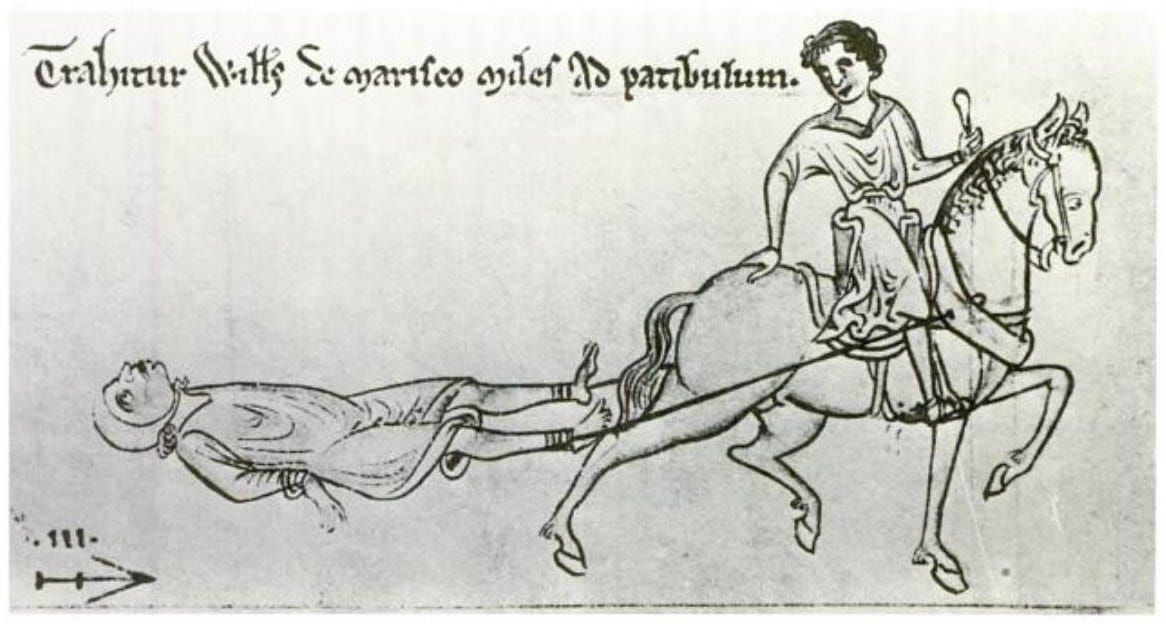
On 14 July they were brought to trial and condemned. Eleven days later, 25 July, the prisoners were dragged by horses to the ‘the penal machine, vulgarly called the gibbet’. They were hanged until dead, cut down, disembowelled, their entrails burnt, the bodies quartered and the pieces distributed to various cities.
This was an act of mercy on King Henry’s part: he had previously ordered one of William’s followers to be torn apart by horses while the man was still alive. At least William and his companions were dead before the real butcher’s work began.
Attached is an illustration of William de Marisco being dragged to execution, from Matthew Paris’s Chronica Majora.
Fascinating stuff. Even after all these years of researching Henry III, I’m still unsure what precisely inspired the assassination attempt at Woodstock in 1238. Definitely among the most bizarre events of his reign.
Some historians I’ve spoken to regard the pirates’ fate as the first example of ‘hanging, drawing and quartering’; I haven’t researched the subject in enough detail to know whether there are earlier examples.
I’ll be visiting Lundy in June; am looking forward to seeing where de Marisco hung out. 👍🏻