Men of War

#OTD in 1402 the battle of Bray took place in Ireland, between the Dubliners and the Leinster Irish.
The English position in Dublin and the Pale had been deteriorating for some time. In 1401 Henry IV tried to shore things up by appointing his thirteen-year-old son, Thomas of Lancaster, lord lieutenant of Ireland.
Thomas arrived in mid-November with reinforcements. According to the Welsh chronicler Adam of Usk, he brought with him ‘a great host to subdue the rebellion of the Irish’. The accounts show that he brought 200 bows, 1,000 sheaves of arrows and about 300 soldiers.
Scarcely a great host, then. And there was little money to pay them either.
By August all of Thomas’s men had deserted for lack of wages, so troops had to be raised from the counties within the Pale of Dublin. On 27 May 1402, for instance, the commons of County Kildare agreed to raise 260 kern to resist the Irish who were plundering their lands.
Men were also sent out to collect ‘smoke-silver’, a tax raised to pay watchmen to look out for Irish raiders.
Things took a dramatic turn on the Feast of the Translation of St Benedict the Abbot (11 July) 1402. On that day the mayor of Dublin, John Drake, led the Dubliners out in force to confront the Irish in battle.
Contemporary Gaelic sources have little to say about the battle of Bray, as it became known. The annals of Connacht and Loch Cé refer instead to a fight in 1401, in which the ‘foreigners’ — the English or Anglo-Irish — defeated the Irish of Leinster and killed many mercenaries led by Tadhg O’Meager, including Tadhg himself.
The annalists may simply have placed the battle under the wrong year: other events in the same chronicles are also misdated.
Nor do we know how many men fought at Bray. In an earlier generation, Dublin had sent 500 men to fight for Edward III in 1332. In an emergency, all able-bodied men between sixteen and sixty could be called up, supported by ‘the country people’ mustered by the keepers of the peace in County Dublin.
The size of the Irish force is equally uncertain. It was thought that the O’Byrnes could raise 300 men and the Mac Murroughs of Wicklow 600, though such figures are largely conjecture.
What we are told is that ‘493 Irish rebels’ were slain at Bray — supposedly ‘all men of war’.
Whether that remarkably precise figure can be trusted is another matter.
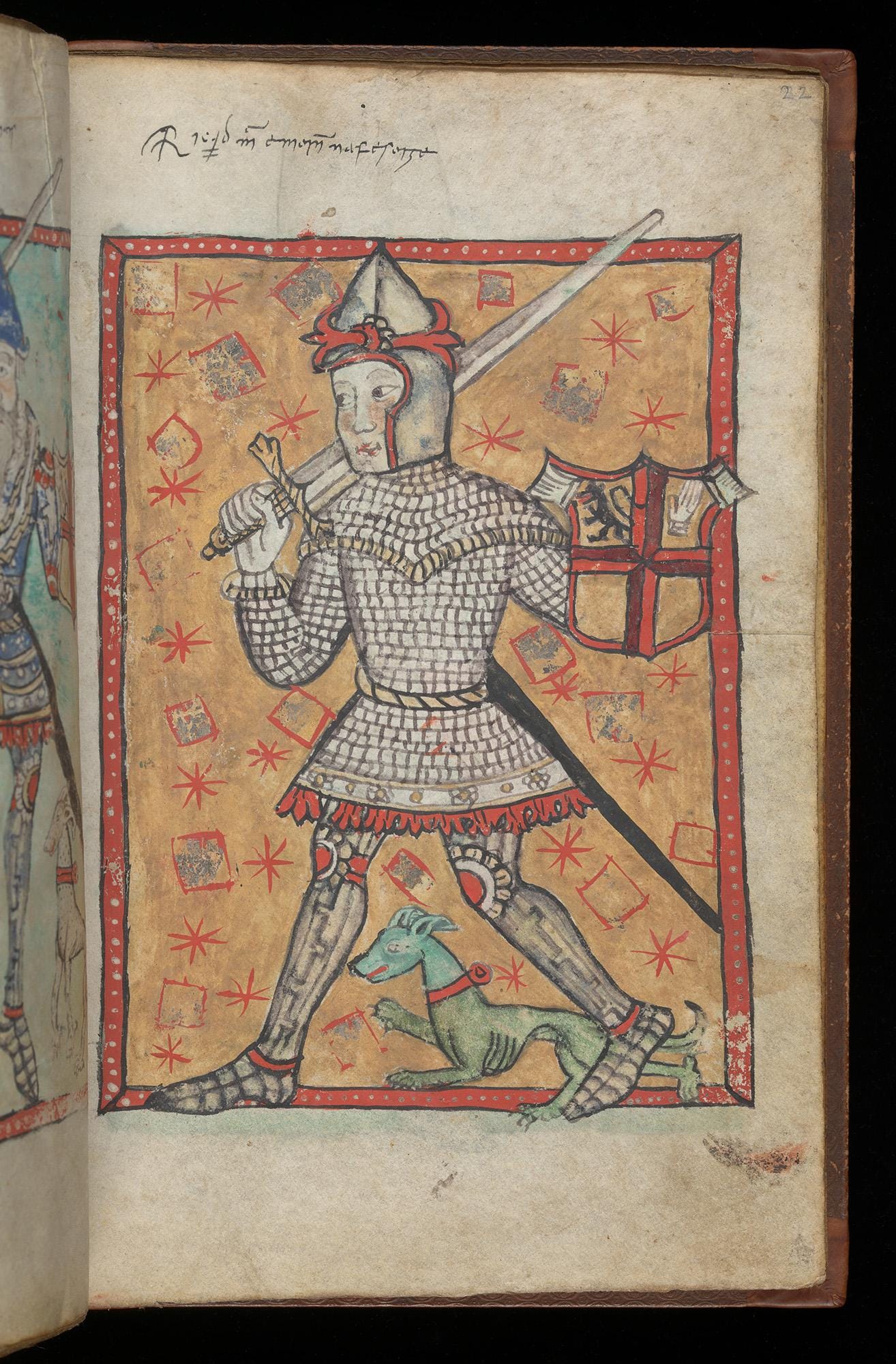
Attached is a pic from fol. 22r of Trinity College Dublin’s Book of the De Burgos: a late-medieval Gaelic manuscript image of Tomás Mac Emoind Albanach, who died in 1402.