Extravagance and extortion

In summer 1302 Philip IV of France summoned Edward I to do military service in Flanders. This was part of Edward’s obligation as a vassal of the French crown.
The two kings had recently been at war. In 1294 Philip invaded and occupied Edward’s lands of Gascony and Ponthieu. The latter was returned via a marriage treaty in 1299, and negotations for the return of Gascony seem to have begun in early 1302. It was eventually restored to Edward in 1303.
The outcome of the war was awkward. Neither side had won; instead they pretended nothing had happened, and the situation reverted to the pre-war status quo. Edward had recovered his continental inheritance, but he and his heirs were still vassals of France.
It had also created lingering resentments, which no amount of diplomacy could rub away. Instead of doing service in person, Edward sent one of his barons of Ponthieu, Jean de Varenne. This made sense, since Ponthieu in northern France lay close to the Flemish border.
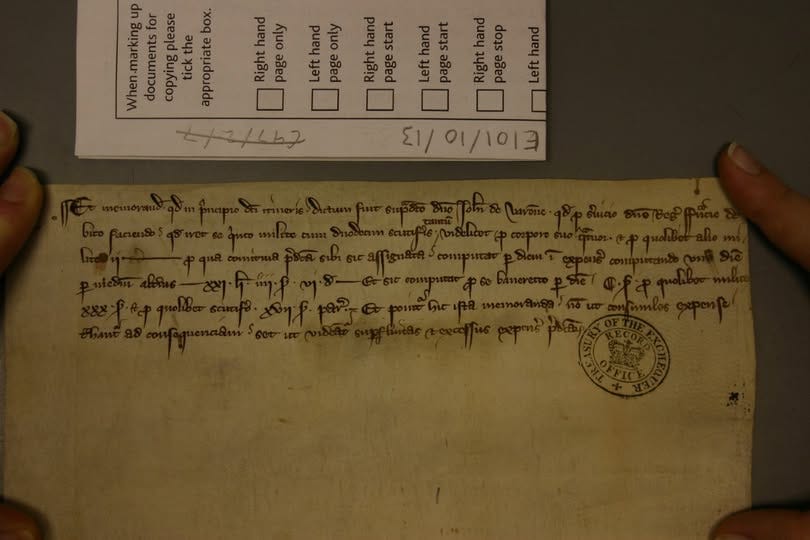
Jean’s record of service survives. Attached is a picture of the memorandum or header for the muster roll, which details the wage payments to Jean and his men. It translates as follows:
‘And memorandum that in the beginning of the said journey it was said to the abovesaid lord John de Varenne that, for doing due service to the lord king of France, he should go, with himself being the fifth knight, with 12 shieldbearers only, viz four for his body and two for each other knight. For which aforesaid company, so assigned to him, he accounts per day in expenses, counting one day through the middle of another, £21 4s 6d. And he so accounts for himself as a banneret per day 100s, for each knight 30s and for each shieldbearer 17s, equally. And there is placed here this memoranda, so that like expenses are not drawn as a consequence, but that the extravagance and excesses of the aforesaid expenses are seen.”
The choice of language here is striking. Jean and his men were charging very high wages for their service: 100 shillings a day for himself, 30 shillings per knight and 17 shillings per shieldbearer. For comparison, the average wage of a knight in England on campaign at this time was 2 shillings per day.
The French clearly regarded this as extortion, hence the reference to ‘extravagance and excesses’ in the last line. As a lord of Ponthieu, Jean may not have been happy about doing military service to a king he had recently been at war with, and only agreed to do it for extremely high pay.
(Translation by Simon Neal at the National Archives).