A Murder at Evesham

#OTD in 1265 the battle or 'murder' of Evesham was fought.
As everyone knows, Simon de Montfort met a very grisly end on the battlefield. Some of the chronicle accounts, translated by Tony Spicer, give different versions of what happened.
The detailed account of Simon’s death, only discovered in 2000 and known as The Last Hours of Simon de Montfort, says the following:
‘Meanwhile, Sir Edward and Sir Gilbert de Clare, earl of Gloucester, had knighted several men in the meadow called Mosham, between Craycombe and Evesham, and had chosen and designated twelve of the strongest and most intrepid men-at-arms; and they knew that they were to kill the earl of Leicester, and break through the ranks forcibly and rapidly in such a way that they would look at no one nor let anyone come between them until they reached the person of the earl...’
This version of events is supported by Guillaume de Nangis, a contemporary chronicler based at the abbey of St Denis near Paris. He says:
‘Edward and the Earl of Gloucester sensing therefore that help from the son to the father was nullified, assembled eleven men to breach his [Simon’s] security...”
However, Nangis then adds the following:
“But Edward considered that in his opinion it was preferable that they [Simon and his followers] be captured rather than killed to which the rest of the nobility unanimously agreed.’
If Nangis is correct, it appears Edward wanted the squad of eleven or twelve men-at-arms to capture Simon, rather than kill him. If he had the support of the nobles, why did this not occur?
It may be that Edward was not in complete control, and was overruled by his co-commanders, Gilbert de Clare and Roger de Mortimer. In that respect it is interesting to discover that the Annals of Oseney, another English chronicle, describes Clare as being in command of the royalist army, not Edward.
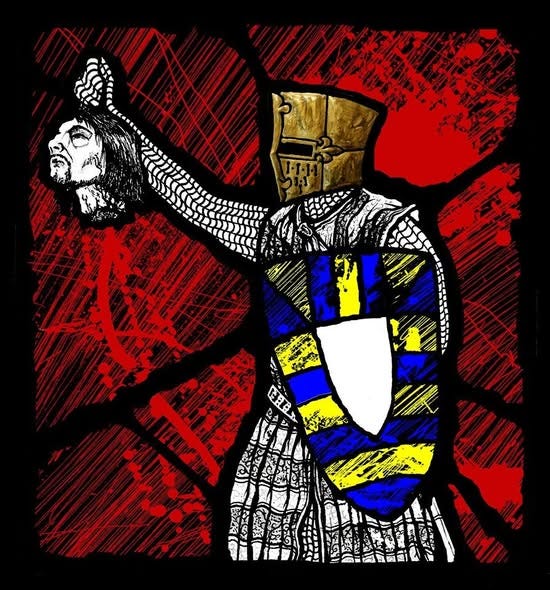
As for Mortimer, he had more reason than any to hate Earl Simon. The two had fought a bitter war on the Marches, in which Simon’s followers destroyed several Mortimer castles and slaughtered his tenantry near Hereford. It was Mortimer who killed Simon on the battlefield and sent his head and testicles, neatly packaged, for Lady Mortimer to use as a table decoration at Wigmore castle.
Seventeen years later, on a cold winter’s day in 1282, it was the Mortimers who struck down Simon’s erstwhile ally, Prince Llywelyn of Wales. They would go on to depose Edward II, judicially murder his half-brother and come within an ace of toppling Edward III.
Sharon Kay Penman details the falls of de Monfort and Llewellyn the Great in two of her classic novels. She brings the men and the conflicts to life in a way that historians never seem to accomplish. Read: Here Be Dragons, Falls the Shadow, and The Reckoning.